Brown patches on a lawn get blamed on drought by default, and sometimes that is exactly right. But drought is only one of at least ten things that leave a lawn patchy, and the fix for each one is completely different. Treat grub damage like drought and you will water a problem that watering cannot solve.
This is the full list we actually check against when we look at a patchy lawn, not the shortlist. Some of these you can sort yourself. Some genuinely need a professional product or a professional eye. We will tell you honestly which is which.
Drought dormancy
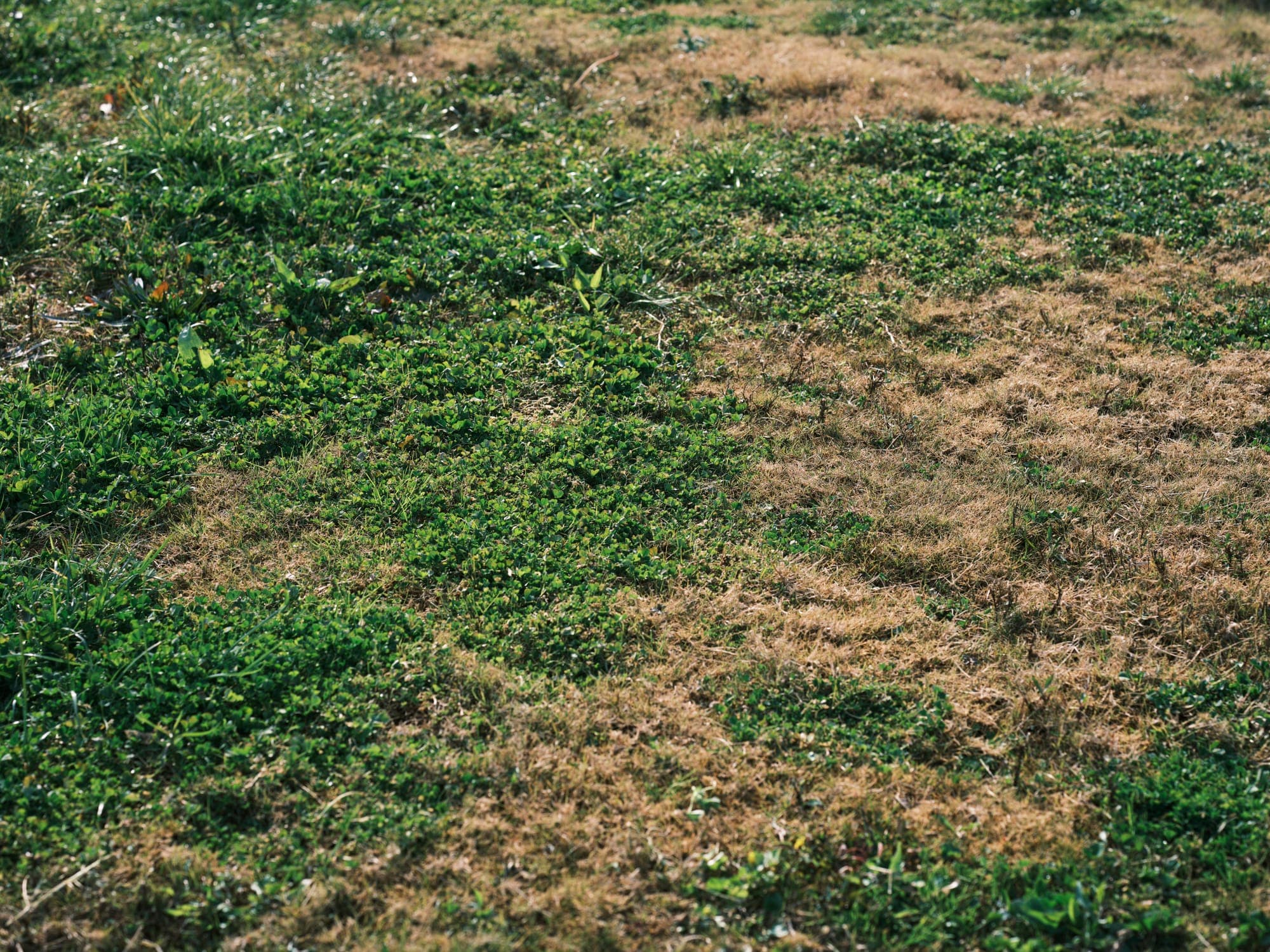
Look: even, straw-brown colour across large open areas, especially anywhere that gets the most sun, while shaded or damp corners often stay greener. The grass itself is uniformly affected rather than patchy in odd shapes.
Fix: nothing urgent. Established grass survives drought by going dormant and greens up again once rain returns, usually within a couple of weeks. If it does not recover once autumn rain arrives, that points to something else underneath, worth a proper renovation rather than more water.
Red thread
Look: pink or reddish, thread-like fungal growth visible on the grass blades themselves, usually in irregular patches a few inches across, most common in a damp summer on a lawn that is short of nitrogen.
Fix: an appropriate feed usually resolves it, since red thread is often a symptom of a hungry lawn rather than a disease that needs treating directly. It rarely kills the grass outright, just weakens the look until it is fed properly.
Fusarium (snow mould)
Look: circular patches of grey, slimy-looking or bleached grass, often first noticed as snow melts or after a mild, wet spell in autumn or winter, sometimes with a faint white or pink fungal fuzz at the patch edge.
Fix: improve airflow and drainage, avoid feeding heavily with nitrogen late in the year which leaves grass soft and vulnerable, and clear fallen leaves promptly so the lawn is not sitting under a damp mat over winter.
Chafer grubs
Look: patches that lift away like loose carpet when you tug them, because the grubs have eaten through the roots underneath. Often gets worse fast in autumn as birds and foxes tear up the turf hunting for the grubs themselves, which does more visible damage than the grubs alone.
Fix: this is a professional-product job, typically a nematode treatment applied at the right time of year, since by the time damage shows the grubs are already established. Worth a proper look rather than reseeding straight over the top, since new grass will get eaten too.
Leatherjackets
Look: similar to chafer grubs, patchy thinning with roots visibly eaten through, most active and most damaging in early spring after developing over winter. Crane flies in the lawn the previous autumn are often the first sign of what is coming.
Fix: the same approach as chafer grubs, a nematode treatment timed correctly is the reliable fix. Bird damage while they hunt the grubs is often what customers actually notice first.
Dog urine
Look: small, sharply defined round patches, often with a ring of darker, lusher green growth around a dead or yellow centre, since the nitrogen concentration kills the middle and fertilises the edge.
Fix: watering the spot promptly after the event dilutes it before it scorches. Established patches usually need reseeding once the salts have washed through, there is no product that reverses the damage once it has happened.
Dry patch (hydrophobic soil)
Look: patches, often on a slope or a raised area, that stay dry and pale even straight after rain or watering, because the soil itself has become water-repellent rather than actually short of water.
Fix: aeration physically breaks the water-repellent layer up and lets moisture in again. A wetting agent applied afterwards helps, but aerating first is what actually makes it work rather than just delaying the same problem.
Fairy rings
Look: a ring or arc of noticeably darker, faster-growing grass, sometimes with mushrooms appearing along it after rain, caused by fungus working through the soil in a spreading circle.
Fix: honestly, mostly cosmetic and hard to remove without digging out and replacing the affected soil, which is disruptive for a problem that is not actually harming the lawn. Most customers choose to live with it once they know that is the trade-off.
Mower scalping
Look: irregular brown patches following the mowing pattern, usually on high spots or where the ground is uneven, where the blade has cut into the crown of the grass rather than just the leaf.
Fix: raise the cutting height and, where the ground itself is genuinely uneven, top-dressing to level it out over time stops it recurring. The scalped grass usually recovers on its own once it stops getting cut too short.
Spilled fuel or chemicals
Look: a sharply defined dead patch with a straight or geometric edge, often near where a mower was filled up or a container was set down, sitting in obvious contrast to the natural, irregular shapes drought or disease leave behind.
Fix: the affected soil is usually contaminated, not just the grass, so digging it out and replacing it with fresh topsoil before reseeding gets a better result than reseeding straight over the top.
When it is worth asking someone to look
A single obvious cause, dog urine, a scalped high spot, is usually fine to sort yourself. Patches that are spreading, that lift away when you tug them, or that keep coming back after you have treated what you thought was the cause, are worth a proper look before you spend more time and product guessing. We diagnose lawns like this every week, and more often than people expect the real cause is not the one that looked most obvious.
Sort it, don't just read about it